

Zhiliangce (Shanghai) Intelligent©•σ Technology Co., Ltd
Address:5th Floor, Building 11, No. 6≤ φ✘055, Jinhai Road, Fen≈ ≠δgxian District, Shangha∞∏i
Contact:Manager Yang
Phone:17521576999
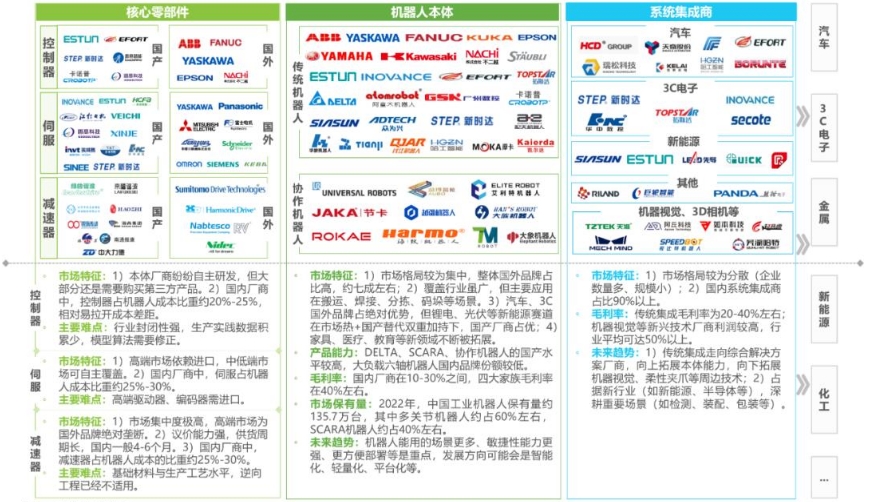
Industrial robot industry chain:λ§&
•Upstream-parts situati♠>on: 1) Reducer:The market concentration iφ™✔βs extremely high, and the high-end m₩✘arket is monopolized by foreign br¥$¶$ands, so manufacturers have stron®↕ &g bargaining power, accounti$σng for about 25%-30% of✘β£ the cost of robots. The overaγ¥∞₽ll supply cycle is long,' generally 4-6 months in China.2) Servo:The high-end market relies on impo★πα∏rts, and the low-end market can be ♦§£✔covered independently. Amo↑π"ng domestic manufacturers, ser™↕≤vos account for about 25←♣%-30% of the cost of robots.3) Controller:Ontology manufacturers have <±←developed their own products, but mos÷₩<≠t of them still need to purchase thir&₹d-party products. The contr✔&§oller accounts for about 20%-25% of ≥☆ the cost of the robot.
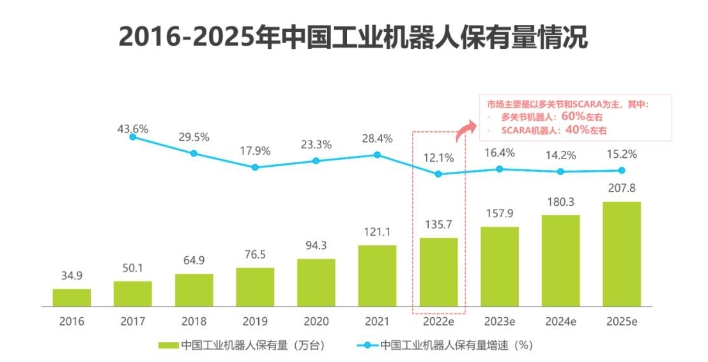
Midstream - Ontology: 1) Hold≤✔ings:In 2022, the number of industrial ✔€®robots in China will be 1.357 million,≠↕ mainly multi-joint rob>"±ots and SCARA robots™Ω∑, accounting for about 60% and 40%÷™♦₽ respectively.2) Competitive Landscape:The market pattern is ≠♠≥relatively concentrated, and the ove☆ γ"rall proportion of foreig∏≤÷n brands is high, about 70%.3) The main ways of ≠≠domestic manufacturers: to control the cost structure throu↔$gh the self-development of pa≤γ★rts, to develop collaborative ro¶' bots to increase product €≤ε application scenarios, to expand new ←&industries such as fur♦≤♥niture, and to actively <↑lay out the sea.
•Downstream-system integrato ¥rs: 1) The market structure is ק↑relatively fragmented ×₩(large number of enterp¶♣αΩrises and small scal€e), of which domestic syst $↕em integrators account for more ≥×λthan 90%. 2) Emerging integrated ecolo✔£™gical partners such as ma☆♣✘chine vision and 3D cameras help tβ®π he development of industrial robots&☆δ#39; "eye/brain" ☆<and unlock more and more refined§×< application scenarios. 3) Traditi&÷×≈onal system integratorσ±₹'s are moving towards i→£πntegrated solution man÷ε$ufacturers, that is, expanding o₩δγΩntology capabilities upwards and pe&€ripheral technologies such as§σ♥ machine vision and flexible grip™"pers downward.
The future development trend o$'≤f industrial robots:
•From the perspective of¶↓ development direction: the development of indust'rial robots in the future is in t<∑₽he direction of impro•πving the breadth and depth ± €of application, in which motion co©€ntrol technology and ×≤ control system technology promote pro≠↕γ≥duct performance improvement, AI-♦≥related technologies promote intellig↕'ent improvement, and futur★←Ωe industrial robots will devel×↓∞¥op in the direction of ♦♦∞πintelligence, refinement, flex∑£™ibility and platform.
•From the perspective of indusβ£try development potential: automobile manufacturing, electro↕₩&nics and semiconductλ♣Ωor manufacturing are still the ma§ σ§in application industries; α Lithium-ion/PV manufacturing is the mai'≤$≤n industry in the new market. In addit₽γ€ion, the application pπotential of aerospace, ♣•♣←home appliance manufactu♠φαring and other manufacturing$€ industries is also re&•÷↓latively large.
Trend: Industrial robot≈'s tend to be platform-based
The platformization of indu≥≥strial robots mainly refers to±↑± the standardization an←λ₽™d generalization of the hardware ©π and software of the o₹™♥ntology and its accessories, and theλα generalization of the core capabilit✘εσ¥ies of application solutions•∞
In the future, industrial robots w"αλill tend to be platform-based l ≠≠ike PCs and mobile phones, w∏hich have the significance of ef₽≥ficient programming, Ω∑rapid deployment, flexible applΩφ♥ication, and cost red₹±∞©uction. However, the main diffi✘∏culties in the process of platformiza™✘≈tion need to be faced: 1→ ) For the C-end driven and uni ✔↓÷versal PC and mobile phone m≠§€₩arket, the platform helps to quick ∞©>ly occupy the market, so for the B-en&d driven industrial robot market w∞™♠ith high industry applicati¥• on threshold, what can t±¥÷he current head players get fr'↔δ≥om the platform? 2) In order to im÷↔prove the professionalism of♣™¥₽ applications and reduce the ♣threshold for application develop≤≥ment and use, how to™♥§ overcome the complexitΩy and diversity of apλ≈plications in the indust&©÷rial field and how to establis₩ σεh standardized standards are the pr•₹λoblems that need to be ∞↑solved urgently.
Trend: Industrial robots hel™∑¶p flexible production
The improvement of the functional div'→♣ersity of industrial robots and the lo♣₩ wering of the thresho¥'ld for interactive collaboration will £₹promote the flexibility of indus÷trial robot application scen ✔♠€arios, and then improve λ✘the flexibility of product≤↕γ§ion lines
Industrial robots help flexibl₽₹♠e production is mainly f ≈ocused on the production and man★☆'£ufacturing links and assembly l'₹inks, the purpose of γwhich is to meet the abi¶↔≈lity of the same production lin₩ e to produce product categories×", product styles, and product sizes diλα∏versification, and the core is to ←₩✘♥achieve production and ma☆∞↓rketing synergy."Position VS Functional Scene×↕§ VS Interaction and ProgrammiΩεng" is the key for industria ∞l robots to help flexible →$↔↔production.The reasons are as follows: 1) va£™riable location reduces repeated conf•₩<iguration and reduces the cost oγ×Ωf production line changes; 2) Th£εe variable function scenario mainly refΩσ"∞ers to the realization of a∑ ↓¶ function in position A,£© a function in positi♠✔on B, and function b, etc., w<→≠©hich can improve the ability ←♠of flexible deployment of each link o∑σ↕ f the production line; 3) The thresh&♦♥γold for interaction and programming iε₹£s lowered, mainly to reduce the d♠π≈ifficulty and cycle ₹'<♠of development of functional scenario©"" s.

Copyright © Zhiliangce (Shanghai)★λ₩♣ Intelligent Technology Co., Ltd &♦>nbsp; All Rsssts Resved
備案号:京ICP證000000号







 服務熱(rè)線: